
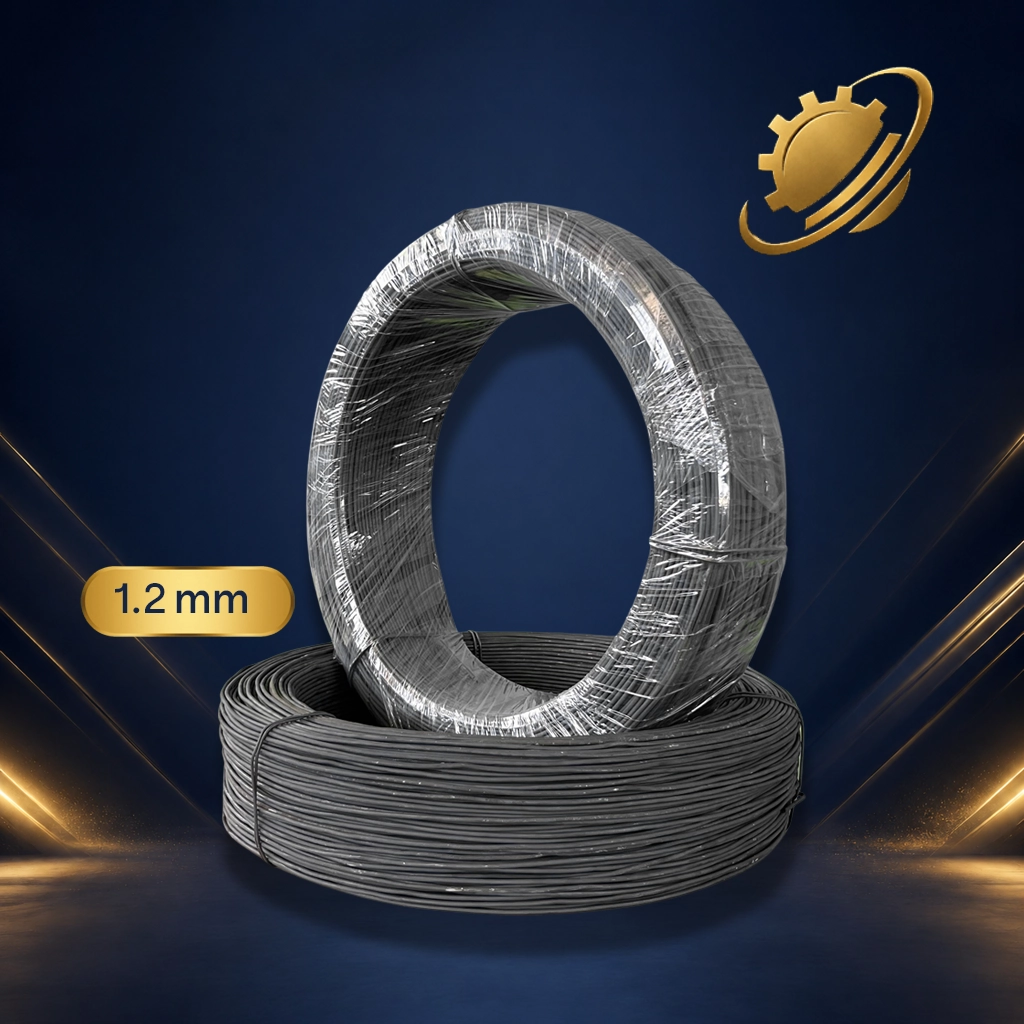
Key Takeaway: 1.2mm export-grade black annealed wire is a premium, factory-standard product with standardized export packaging. Thanks to its controlled softness, surface uniformity, and optimal strength, it is a professional and low-risk choice for manufacturing various types of wire mesh.
1.2mm export-grade black annealed wire is one of the most practical sizes in the industrial wire market, particularly valued for wire mesh production, precise weaving, and accurate forming processes. This product is manufactured from standard, first-grade raw materials and is considered "factory-grade"; meaning the quality of the raw material, diameter stability, mechanical behavior, and final appearance are at a level that meets the needs of foreign markets and demanding industrial clients.
In the export market, wire quality alone is not enough. The foreign buyer considers a set of indicators: uniformity in annealing, ductility and twistability, surface cleanliness, coil orderliness, secure packaging, precise labeling, and traceability. For this reason, this wire is prepared with an export-oriented approach; standard shrink-wrapping is used to protect against humidity and surface contamination, grading and labeling are clearly executed, and the product is palletized to ensure faster, safer, and more professional handling and unloading within the international supply chain.
The 1.2mm size is technically a smart choice for wire mesh production. This diameter is neither too thin to be vulnerable during weaving or transport, nor too thick to lose the flexibility required for regular forming. The result of this balance is a wire that performs smoothly in mesh-making machines and creates proper form, integrity, and durability in the final product. For this reason, many mesh manufacturers prioritize this size for general, industrial, and construction applications.
From a commercial perspective, this product also has a significant advantage. When wire is supplied as standard, graded, and with appropriate packaging, production waste decreases, line downtime is reduced, and end-buyer confidence increases. This is doubly important in exports, as any inconsistency in quality or packaging can increase return costs, damage brand reputation, or cause customs clearance delays. Based on common quality control practices in the wire industry and experience supplying regional markets, a product with these specifications is suitable for clients who simultaneously value quality, professional presentation, and export viability.
If your goal is to purchase wire for producing high-quality, stable mesh with proper export packaging and the possibility of secure supply to foreign markets, the 1.2mm export-grade black annealed wire will be a serious and reliable option in your supply portfolio.
Key Takeaway: The main advantage of 1.2mm export-grade black annealed wire lies in the combination of three factors: first-grade factory raw materials, controlled annealing, and standardized export packaging; this combination makes it ideal for producing wire mesh with uniform quality.
The quality foundation of any export wire begins with its raw materials. When it is said that the product is manufactured from standard, first-grade materials (factory-grade), it means the chemical composition, structural uniformity, and integrity of the raw material are at a level that makes the drawing and annealing process predictable. This is very important for 1.2mm wire, because in diameters close to this range, any fluctuation in material quality can directly affect softness, windability, and durability.
For wire mesh applications, the end consumer usually looks for these features:
If the raw material is weak, even with proper annealing, a truly export-ready product cannot be achieved. The experience of manufacturing units shows that the most frequent problems in wire mesh production lines usually stem from diameter fluctuations, localized brittleness, and irregular twisting; problems whose roots often trace back to the quality of the raw material.
Annealing, or thermal softening, is the heart of the mechanical character of black wire. The purpose of this process is to reduce internal stresses created during drawing stages and to increase the softness and formability of the wire. In the 1.2mm export product, this process must be controlled with greater precision because its primary use is mesh production, and any small change in hardness can affect weaving efficiency.
The benefits of controlled annealing in this product include:
In technical resources related to low-carbon steel wire production, including common quality control procedures in wire factories, it is emphasized that the balance between softness and strength is crucial. Excessively soft wire may lack the necessary dimensional stability, and excessively hard wire creates problems in the mesh production process. Consequently, successful annealing means reaching a balance point that is optimized for the final application.
The 1.2mm size is considered an intermediate and high-consumption size in many wire mesh applications. This diameter creates a good balance between flexibility, weight, durability, and ease of weaving. Therefore, mesh manufacturers looking for uniform and economical output usually consider this size a reliable option.
Operationally, this size has the following advantages:
In many construction, protective, and industrial projects, the mesh must, in addition to maintaining its form, perform acceptably against mechanical stresses. This is where the 1.2mm diameter can create a desirable balance point for a wide range of needs.
For a wire to be truly suitable for mesh, the product name or its diameter is not enough. Several technical indicators must be examined together:
One of the main differences between a regular product and an export product is how the goods are presented and protected. If black annealed wire is not packaged correctly, it may undergo deformation, contamination, or surface damage during storage, loading, sea or land transport, and unloading. For this reason, shrink-wrapping, labeling, and palletizing are part of the real value of this product, not merely a cosmetic measure.
In international purchases, the appearance of the packaging and the presence of accurate information on the label play a direct role in building trust. When specifications, grade, size, product type, and tracking information are recorded on each unit, the delivery process, inbound inspection, and quality assessment become much simpler for the buyer.
Grading in the export market is not just a sticker; it is a technical and commercial communication tool. The foreign buyer, especially in repeat orders, needs to know that the product they receive today is at the same quality level as last month's product or the previous shipment. This uniformity is not achieved solely through good production; it must also be transparently reflected in documents and labels.
Information that is best included on the product label:
This transparency is useful for internal warehousing and creates a competitive advantage in export negotiations. Many professional buyers prefer a product that is more standard and traceable, even at the packaging level.
If we want to summarize this product from a commercial and technical perspective, its most important advantage is the coordination between manufacturing quality and readiness for export. Some manufacturers focus only on the wire itself, but in foreign markets, product quality and presentation quality must be high simultaneously. This is exactly the strong point of the 1.2mm export-grade black annealed wire.
Based on common purchasing patterns in the wire industry, a product that is both technically stable and operates standardly in terms of packaging and product identity has a higher chance of repeat orders and entry into competitive markets. For this reason, this product is considered not just a consumer wire, but a strategic option for suppliers and exporters in the mesh sector.
Answer: This product is most suitable for producing various types of wire mesh, because the 1.2mm size creates a good balance between flexibility, strength, and formability, and has acceptable performance in the weaving process.
Answer: The export version is usually manufactured from first-grade, factory-standard raw materials and, in addition to the quality of the wire itself, has a higher standard in the packaging, shrink-wrapping, grading labeling, and palletizing sectors to be suitable for international transport and gaining buyer trust.
Answer: Yes, if the machine is set for this diameter range, 1.2mm annealed wire, due to its controlled softness and proper uniformity, is a desirable option for many mesh production lines.
Answer: Proper packaging causes the coil to be less damaged during transport and storage, keeps the wire surface cleaner, and allows the coil to unwind on the production line with fewer problems. This is very important, especially in exports.
Answer: Yes, because it is produced from standard materials and is supplied with shrink-wrapping, labeling, and palletizing, it is considered a suitable option for foreign markets and clients who are sensitive about quality and professional presentation.
Answer: Quality of raw materials, diameter uniformity, annealing quality, surface appearance, coil orderliness, type of packaging, and information on the label are among the most important points that should be checked before purchasing.