
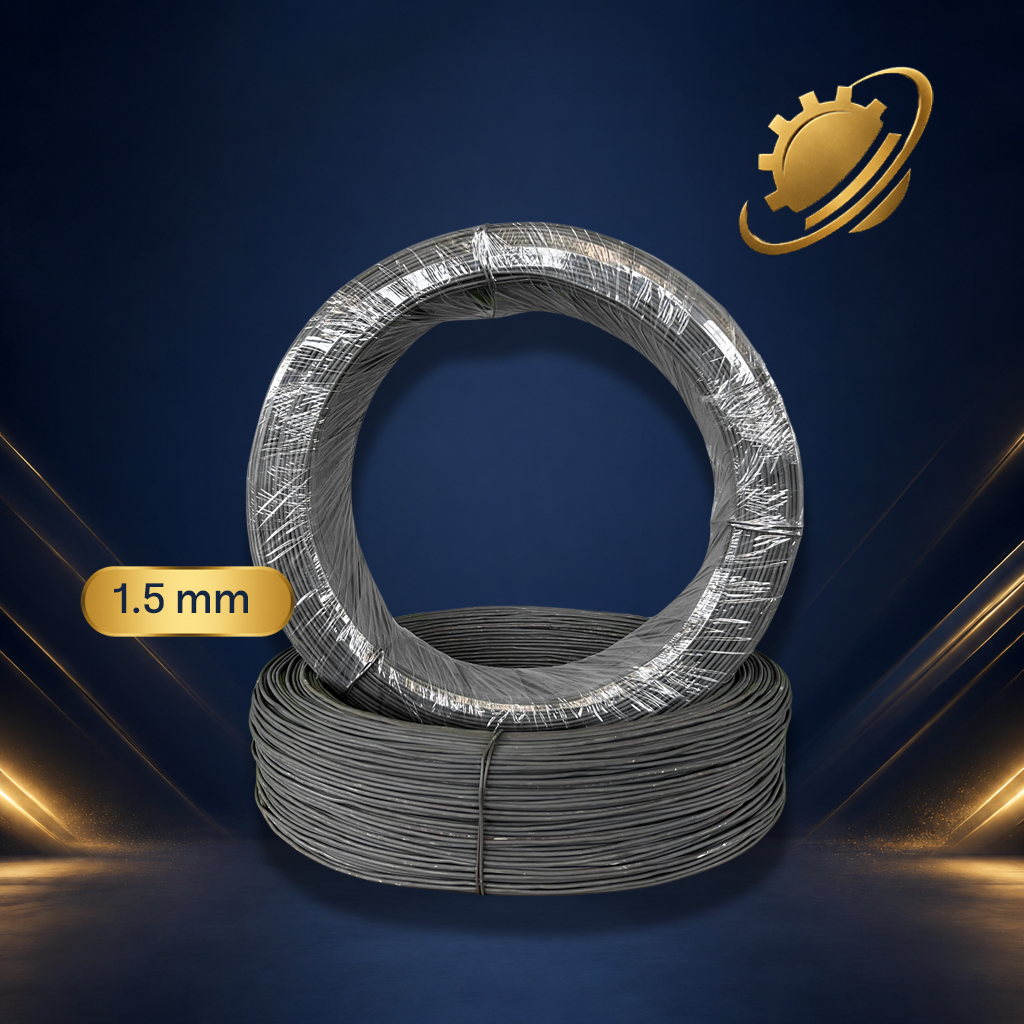
Key Takeaway: 1.5mm export-grade black annealed wire, relying on premium factory-grade raw materials, is an engineered solution for construction and concrete formwork projects. With advanced export packaging, it guarantees the quality and integrity of the product until the moment of delivery.
1.5mm export-grade black annealed wire, as a critical tool in the construction industry, plays a key role in the strength and precision of concrete formwork. Choosing the 1.5mm size is a strategic decision; this diameter creates an optimal balance between tensile strength and knotting ability. In massive construction projects and export activities where accuracy and execution speed are priorities, a wire that can handle structural loading while remaining soft and break-resistant is a necessity.
This wire is produced using premium "factory-grade" materials. The difference between factory-grade wire and standard drawn products lies in the integrity of the raw material. When the raw material is first-grade and free of impurities, the metal's molecular structure rearranges during the annealing process, ensuring the final product is perfectly uniform along the entire length of the coil. For users involved in concrete formwork, this uniformity means reduced waste. A wire that breaks while being twisted around rebar or connecting concrete forms not only wastes workers' time but also increases project costs due to slower execution.
The export approach for this product is not limited to the quality of the metal; packaging standards have also been optimized for international markets. Each coil is precisely shrink-wrapped to be resistant to humidity and environmental factors that cause premature rusting. Precise labeling based on standard grading allows wholesale buyers and trading companies to manage inventory and quality control with high precision. Final palletization ensures the goods sustain minimal physical damage during sea or land transport.
Ultimately, this product is designed for civil engineering companies looking for consistent quality in their projects, as well as traders who want to export a product with global standards. Using this wire in concrete formwork means ensuring a connection that maintains its stability until the concrete dries and even thereafter. This combination of manufacturing quality and product presentation standards has made our 1.5mm wire an unrivaled choice in the market.
Key Takeaway: The technical superiority of this wire lies in maintaining mechanical uniformity at the 1.5mm size, achieved through controlled annealing and protected against environmental hazards by export-grade packaging (shrink-wrapping and palletization).
When discussing black (annealed) wire, the first parameter determining quality is the carbon content in the steel and the structural integrity of the initial billet. A product manufactured from factory-grade material (wires drawn from sound initial wire rod) has entirely different physical properties compared to wires produced from melted scrap metal.
In concrete formwork applications, the wire is subjected to intense tensile force to hold the forms together. If the material contains impurities, stress concentration points develop in the wire, eventually leading to breakage during tightening. Our export-grade wires maintain necessary elasticity by controlling the percentage of carbon and sulfur/phosphorus impurities.
Features of premium-grade material:
The annealing or thermal softening process acts as a maturation stage for black wire. For 1.5mm wire, precise furnace temperature regulation and cooling time are of critical importance. The wire must be softened enough for construction workers to easily twist and knot it around the formwork by hand or using pliers.
If annealing is incomplete, the wire remains hard and brittle. If excessive, the wire loses its elasticity, overstretching and unraveling under the pressure of the concrete forms. In our export wire production, we utilize computerized heat control systems to ensure every coil reaches exactly the desired degree of hardness.
Concrete formwork requires wire that can both withstand the lateral pressures of wet concrete and not dislodge during concrete vibrator shakes. In civil engineering, the 1.5mm size is recognized as the optimal diameter for rebar tying and formwork wires.
| Technical Feature | Impact on Formwork | Why it's better in export version? |
|---|---|---|
| 1.5mm Diameter | Balance of strength and weight | Global standard for withstanding formwork pressure |
| Softness (Annealed) | Fast and easy knotting | Less worker fatigue and higher execution speed |
| Tensile Strength | Stability against concrete pressure | No knot unraveling during concrete pouring |
| Surface Uniformity | Ease of passing through forms | Reduced wear on worker tools |
In global markets, a product with excellent quality but lacking necessary packaging standards is recognized as second-rate. We have exported the 1.5mm wire with an understanding of logistical requirements.
Concrete exerts intense hydrostatic pressure on the formwork body when poured. The wire must withstand this pressure. The 1.5mm wire with factory-grade material has a specific Yield Strength that is strictly monitored in our production standards.
In large projects, the breakage of even a single wire can cause formwork bulging and concrete surface damage, which carries very high repair costs. Therefore, choosing guaranteed-quality export wire is actually an investment in reducing project repair and rectification costs.
Key Takeaway: Common questions regarding this product include the difference between export wire and domestic market wire, usage methods in formwork, packaging benefits, shipping conditions, and quality testing methods.
Answer: Because it is produced from factory-grade raw materials, this wire has extremely high flexibility for knotting while simultaneously possessing sufficient strength to withstand the hydrostatic pressures of concrete, leading to increased speed and precision in civil projects.
Answer: In the export product, each coil is shrink-wrapped to prevent rusting, grade specification labels are attached to the coil, and for ease of loading and unloading, all coils are placed on pallets.
Answer: Black wire is inherently sensitive to humidity; however, in our export version, professional shrink-wrapping has made this wire highly resistant to atmospheric conditions and ambient humidity during transport and storage.
Answer: "Factory-grade" means using high-quality steel billets and drawing the wire from those billets, unlike non-factory wires produced from melted mixed scrap, which lack the necessary uniformity.
Answer: Yes, given compliance with material quality standards, secure packaging, and product traceability through grading labels, this product is completely designed for export markets.