
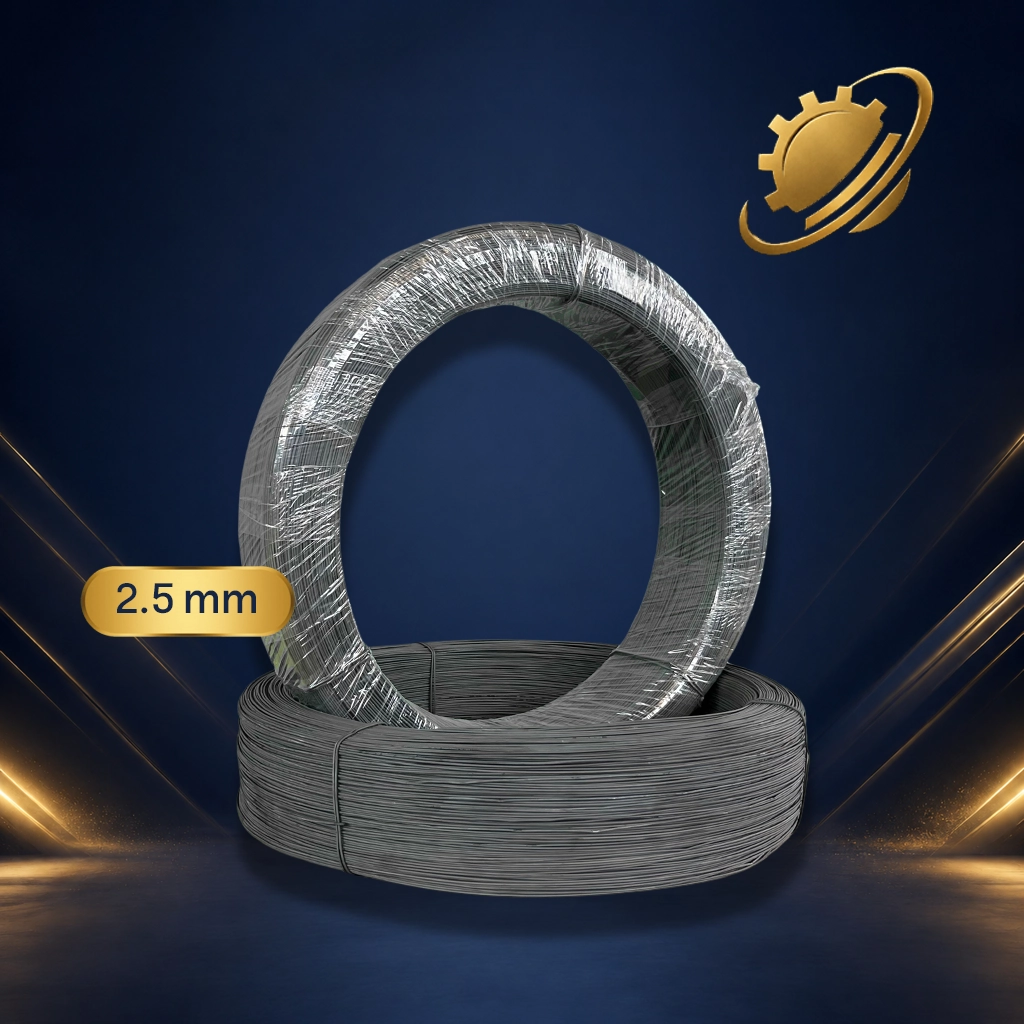
Key Takeaway: Zarrin Navard Spadana's 2.5mm black annealed wire is produced using factory-grade steel raw materials. By providing maximum tensile strength and flexibility, it is an unrivaled choice for heavy-duty rebar tying and professional construction applications.
In the world of industrial construction and massive civil engineering projects, using low-quality wire not only slows down execution speed but also compromises structural integrity. Zarrin Navard's 2.5mm black wire is produced to address these challenges and set a new standard in the market. Unlike products commonly found in the market that are unfortunately derived from recycled scrap metal (non-factory grade), our 2.5mm wire is produced entirely from prime steel billets. This fundamental difference in raw material guarantees uniform quality throughout the entire length of the coil.
Due to its 2.5mm diameter, this wire is designed for conditions requiring the containment of heavy rebar or creating connections with high mechanical load-bearing capacity. The annealing (baking) process for this product is carried out with precise temperature control, ensuring the final product possesses excellent flexibility for knotting with rebar pliers while maintaining steel hardness.
We fully understand the challenges customers face in export markets. Humidity, oxidation during maritime transport, and storage difficulties are primary concerns. That is why Zarrin Navard's export wires are supplied with advanced shrink-wrapping technology, which acts like armor, protecting the steel from environmental factors. Furthermore, our labeling system with precise grading and systematic palletization ensures buyers that the cargo sent from Zarrin Navard Spadana reaches the final destination anywhere in the world with the same factory-output quality. This product is a combination of engineering technical knowledge and commitment to international standards.
Key Takeaway: The precise engineering of the annealing process and diameter control in the 2.5mm size ensures that this wire maintains standard tensile strength while being completely resistant to metal fatigue and breakage during repeated knotting.
The difference between a regular wire and Zarrin Navard's factory-grade wire lies in its crystalline structure. After cold drawing, our 2.5mm wire undergoes an annealing process in atmosphere-controlled furnaces. During this stage, internal stresses caused by drawing are eliminated, and the metal's grain structure reaches equilibrium. This technical feature ensures that contractors do not face problems such as "brittle wire" or "sudden knot breakage" while tying heavy rebar.
In column and foundation rebar tying where high-gauge rebars are used, 1.5mm or 2.0mm wire may stretch or break under the heavy pressure of the rebar. Zarrin Navard's 2.5mm wire, as a reinforced option, creates extremely strong knots that stabilize the position of the rebars well until and even after concrete pouring.
| Technical Feature | Zarrin Navard 2.5mm Wire | Recycled Wire (Non-Factory) |
|---|---|---|
| Raw Material | Factory-grade steel billet | Resmelted scrap |
| Flexibility | Very High (Soft and pliable) | Brittle and non-uniform |
| Shelf Life | Very long (Shrink-wrapped) | Short (Rusts quickly) |
| On-site Waste Rate | Near zero | High (Over 10%) |
One of the main pillars in the wire industry is how goods are prepared for shipment. Our export product is not just black wire; it is a complete logistics package. Our wires are shrink-wrapped in orderly coils. Shrink-wrapping not only prevents moisture and oxygen (the main causes of corrosion) from penetrating but also makes transport safer.
Answer: Although this wire is optimized for heavy rebar tying, its flexibility makes it usable in many other industrial applications. However, for very thin rebars, wires with smaller diameters may be more cost-effective.
Answer: This packaging largely prevents direct contact of steel with atmospheric moisture. In standard weather conditions, it increases the useful shelf life of the wire from a few weeks to several months, which is essential for maritime export.
Answer: Factory-grade means it is produced from pure steel billets, and no melted scrap or iron waste is used in its production process. This makes the product's tensile strength predictable and its quality completely uniform.
Answer: Palletization is an investment that creates more profitability. It brings the risk of wire damage during transport close to zero and significantly reduces the buyer's final costs by reducing waste at the destination.
Answer: Yes, as a specialized manufacturer, Zarrin Navard Spadana can adjust the degree of baking (hardness and softness) according to the technical requirements of your project for large export orders.