
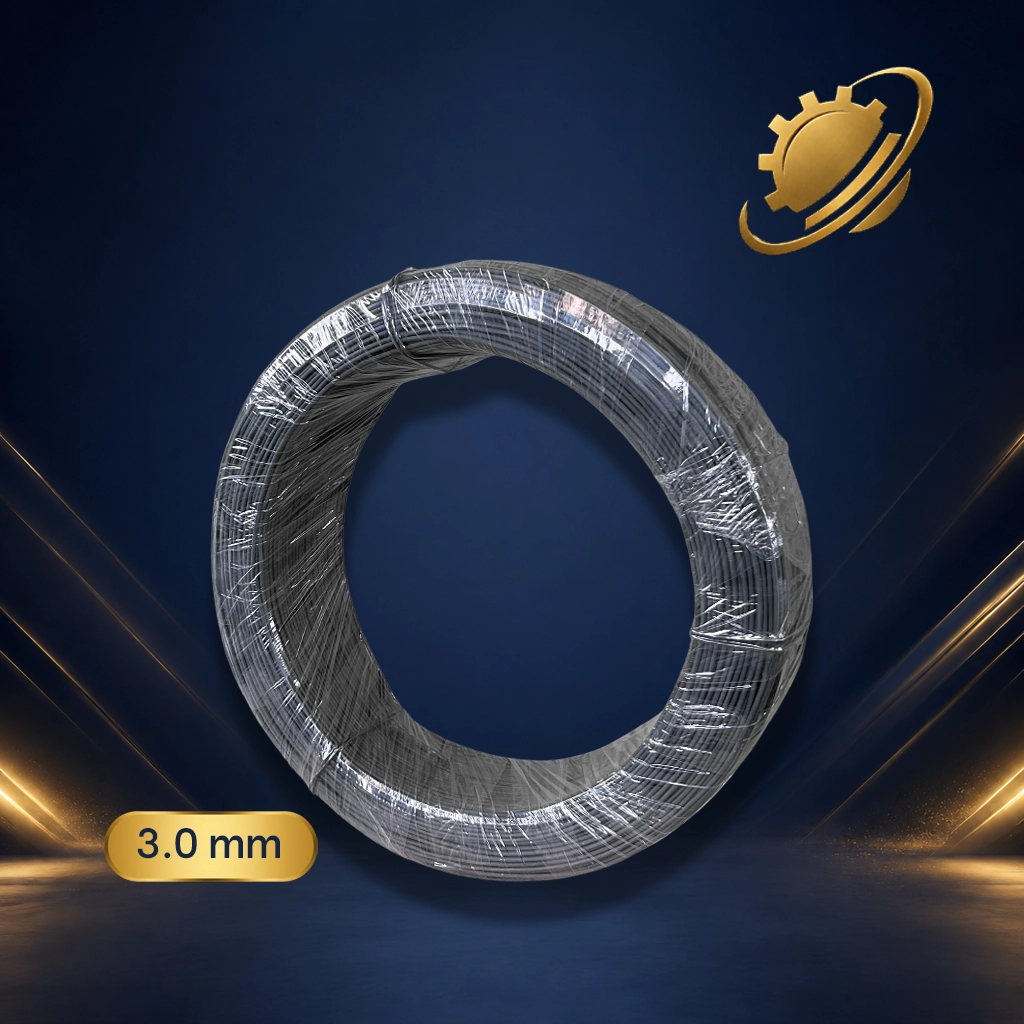
Key Takeaway: Zarrin Navard's 3.0mm black wire is a high-gauge, high-tensile strength product. Thanks to factory-grade raw materials and a precision annealing process, it is recognized as the superior standard for industrial fencing, security barriers, and large-scale export fencing projects.
In the fencing and perimeter security industry, choosing the right wire determines the structure's longevity and stability against environmental factors and physical stress. Zarrin Navard Spadana's 3.0mm wire is designed to meet these engineering requirements. Unlike market products often derived from remelted scrap (non-factory grade), our product is manufactured from prime steel billets. This fundamental difference ensures that the wire does not experience breakage, deformation, or premature corrosion during the fencing process.
The primary application of this product is in industrial fencing, military zones, agriculture, and perimeter security. The 3.0mm thickness creates an ideal balance between flexibility and strength, perfectly suited to withstand tensile stresses caused by wind, animal impact, or physical environmental pressures.
At Zarrin Navard, we view exports as part of our production identity. To ensure our 3.0mm wire reaches global markets undamaged, we utilize advanced shrink-wrapping technology. This protective layer shields coils against moisture and oxidation during long maritime transits and long-term storage. Our labeling system with specific grading ensures full technical transparency for buyers, and our standard palletization makes cargo handling at international ports and warehouses as simple as possible. This product is not just wire; it is an engineering solution for durable fencing projects.
Key Takeaway: The precision engineering of the annealing process in the 3.0mm wire creates a uniform microscopic steel structure, minimizing breakage rates in fencing machines and significantly increasing production line efficiency.
When choosing wire for fencing, diameter or thickness plays the primary role in the fence's overall endurance. Thinner wires succumb to lateral pressure, leading to sagging and loosening. The 3.0mm size, considered one of the standard diameters for heavy-duty wire, possesses high tensile strength. This wire is annealed to maintain structural integrity while providing the necessary malleability to bend around fence posts or weave neatly in automatic machinery.
Using "non-factory grade" wire (produced from scrap) in the 3.0mm size is a major risk; impurities in scrap iron cause the wire to snap at points where it is subjected to the pressure of the weaving machine. Zarrin Navard wire, due to its factory-grade structure, is free from such surface defects.
The annealing process for 3.0mm black wire requires more time than thinner sizes due to its higher thickness. At Zarrin Navard, we perform this process in precision furnaces with controlled atmospheres. This ensures that the carbon in the steel is uniformly distributed, allowing the wire to shed unwanted "springiness" (seen in raw wire) and achieve the optimal degree of softness.
Exporting black wire without protective packaging is a mistake many manufacturers make. Environmental humidity in maritime containers can oxidize the wire surface in less than a week. Our shrink-wrap packaging is an impenetrable barrier against these factors.
Our pallets are designed with international standard dimensions to maximize weight capacity in 20ft and 40ft containers, reducing maritime shipping costs for the end buyer. Additionally, graded labels on each pallet include all technical specifications (diameter, weight, production date), making the customs inspection process for foreign buyers seamless.
Answer: The 3.0mm size has high tensile strength and is less prone to deformation or breakage under physical environmental forces. For industrial and perimeter fencing, this size strikes an excellent balance between price and performance.
Answer: Yes, our 3.0mm black wire, as a standard raw material, can easily undergo galvanization (hot or cold) if used in corrosive environments, maintaining its excellent quality.
Answer: Standard wires are usually stored without any covering and are exposed to oxidation. Our shrink-wrapping guarantees the product's integrity during long-term storage and maritime transit.
Answer: Grading indicates the mechanical and chemical standards of the wire. By including these specifications on the label, we assure project engineers that the product is designed exactly to meet their technical requirements.