
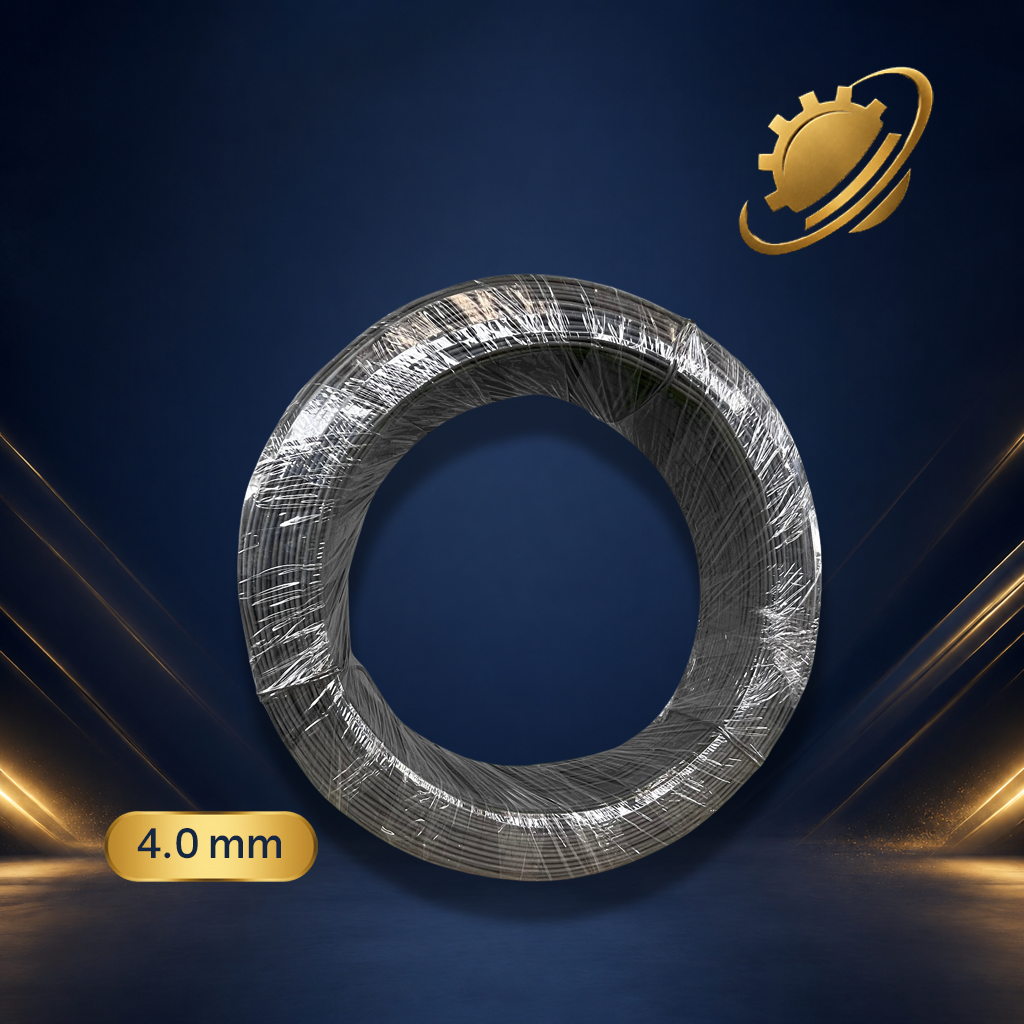
Key Takeaway: Zarrin Navard Spadana’s export-grade 4.0 mm black wire, produced from prime factory-grade raw materials, offers high strength, controlled flexibility, and standard export packaging, making it one of the best choices for heavy fencing and industrial perimeter applications.
Black wire with a 4.0 mm diameter is one of the most important and practical sizes for projects where durability, strength, and structural stability are highly critical. When the goal is heavy-duty fencing, perimeter barriers for industrial sites, workshops, large agricultural lands, infrastructure projects, and security applications, choosing the right wire diameter has a direct impact on the final quality of the work. In this context, Zarrin Navard Spadana’s 4.0 mm annealed black wire is recognized as a professional product for both domestic and export markets due to its high manufacturing quality and reliable technical specifications.
This product is manufactured from standard, factory-grade raw materials. Using first-class material ensures a uniform wire structure, free from harmful impurities and with stable mechanical behavior. This is highly important for professional buyers, because products made from non-standard or scrap-based materials may suffer from breakage, surface cracking, quality loss during stretching or bending, and even reduced service life. In contrast, Zarrin Navard factory-grade wire is designed for heavy-duty applications and delivers predictable performance during installation.
The annealing process also plays a key role in the quality of this product. In this process, the wire is heat-treated in a way that preserves its strength while providing the flexibility needed for shaping and use in fencing systems. This balance between softness and resistance is exactly what contractors and fence manufacturers need.
From an export perspective, this product is prepared with a professional approach. The shrink-wrapped packaging prevents direct contact between the wire and moisture or corrosive agents. Accurate labeling and grading make it easy for buyers and warehouse operators to identify product specifications quickly. In addition, organized palletizing enables safe transport and faster unloading within the international supply chain. For this reason, Zarrin Navard’s 4.0 mm black wire is not just a simple commodity, but an engineered solution for professional and export fencing projects.
Key Takeaway: Due to its larger diameter, higher mechanical resistance, and uniform factory-grade structure, 4.0 mm black wire is considered a more stable option than lighter sizes for heavy fencing and industrial use.
In fencing projects, wire diameter is one of the most important indicators of final quality and durability. The larger the wire diameter, the greater its ability to withstand tensile stress, environmental impact, and pressure caused by wind or external contact. Compared with smaller sizes such as 2.5 mm or 3.0 mm, the 4.0 mm wire is better suited for projects where security, longevity, and strength are the top priorities.
In perimeter fencing around sheds, factories, open yards, military facilities, large orchards, and infrastructure projects, using weaker sizes often leads to reduced stability. Thanks to its larger cross-section, 4.0 mm wire performs more reliably under tension and deformation and helps reduce the risk of fence loosening.
When we talk about industrial fencing, we do not mean a regular fence. In these projects, the structure must provide sufficient resistance against the following:
Because of its larger diameter and balanced mechanical properties, 4.0 mm black wire can deliver more dependable performance in such conditions than lighter sizes. This is especially important for export customers, who expect the delivered product to arrive accurate, intact, and ready for use.
One of the main differences between professional wire and ordinary market wire is the raw material. Zarrin Navard Spadana wire is manufactured from standard, factory-grade materials. This means the steel chemistry is more uniform and more controllable, resulting in more stable mechanical behavior in the final product.
In contrast, products made from scrap or low-quality material usually come with issues such as:
In fence production lines, wire uniformity is very important. If the diameter is inconsistent or the product surface contains structural defects, weaving and installation processes can be disrupted. In a factory-grade product, the wire behaves more consistently throughout the operation. This reduces production time and prevents unwanted stoppages during weaving or installation.
Based on common quality control practices in the steel industry, wire produced from uniform raw materials shows a lower rejection rate in tensile, bending, and load-resistance tests. This is exactly the advantage that the professional and export market seeks.
Annealing is a process in which the wire, after drawing, is subjected to controlled heat treatment. The purpose of this process is to reduce internal stress, improve flexibility, and prepare the product for operational use. In the 4.0 mm size, precise control of this process becomes even more important, because any error in temperature or time may result in either excessive softness or unwanted brittleness remaining in the product.
In fencing applications, the wire must provide enough resistance while also behaving properly during shaping, cutting, or fastening. If the wire is too hard, the risk of cracking or breaking at the bending point increases. If it is too soft, the fence structure may lose its shape over time. The advantage of Zarrin Navard’s 4.0 mm black wire is that its annealing is designed to achieve exactly this balance.
Technical benefits of proper annealing:
A product intended for foreign markets must not only be high quality when it leaves the factory, but must also maintain that quality upon arrival. For this reason, packaging is part of the final product quality, not an optional extra.
In export-grade 4.0 mm black wire, shrink wrapping serves as the primary protective layer. This covering reduces direct exposure to moisture, dust, and environmental contamination. During sea transport and long-term storage, this advantage is very important, because unprotected wire is more likely to suffer surface oxidation.
Accurate labeling is one of the signs of a professional export product. Including details such as size, grade, weight, packaging type, and identification code makes receiving, storing, and tracking easier for the buyer. This is especially important for customers ordering multiple sizes.
Palletizing also provides several advantages:
This product is a logical and cost-effective choice for the following groups:
Before ordering this product, the buyer should carefully evaluate the following points:
In many projects, choosing the wrong size or selecting non-factory-grade material leads to rework, lower installation quality, and higher final costs. For this reason, wire should be purchased based on real technical specifications, not just the initial price. Market experience shows that using factory-grade, properly packaged wire reduces hidden project costs and lowers the risk of returns or customer dissatisfaction.
Answer: This size is most suitable for heavy fencing, industrial barriers, security perimeters, workshops, factories, and projects where strength and durability matter more than in light fencing systems.
Answer: Factory-grade wire is made from standard, first-class raw materials and has a more uniform structure, while scrap-based wire may contain more impurities, irregular mechanical behavior, and a higher risk of failure.
Answer: Yes, because during international transport and storage, contact with moisture and contamination can damage the surface quality of the wire. Shrink wrapping helps the product arrive in better condition and with a cleaner appearance.
Answer: Yes. Proper annealing preserves the required strength while giving the wire more controlled flexibility, allowing better performance during installation and shaping.
Answer: Because accurate labeling makes it easy to identify each coil, reduces storage errors, and simplifies order control and product traceability in export purchases.